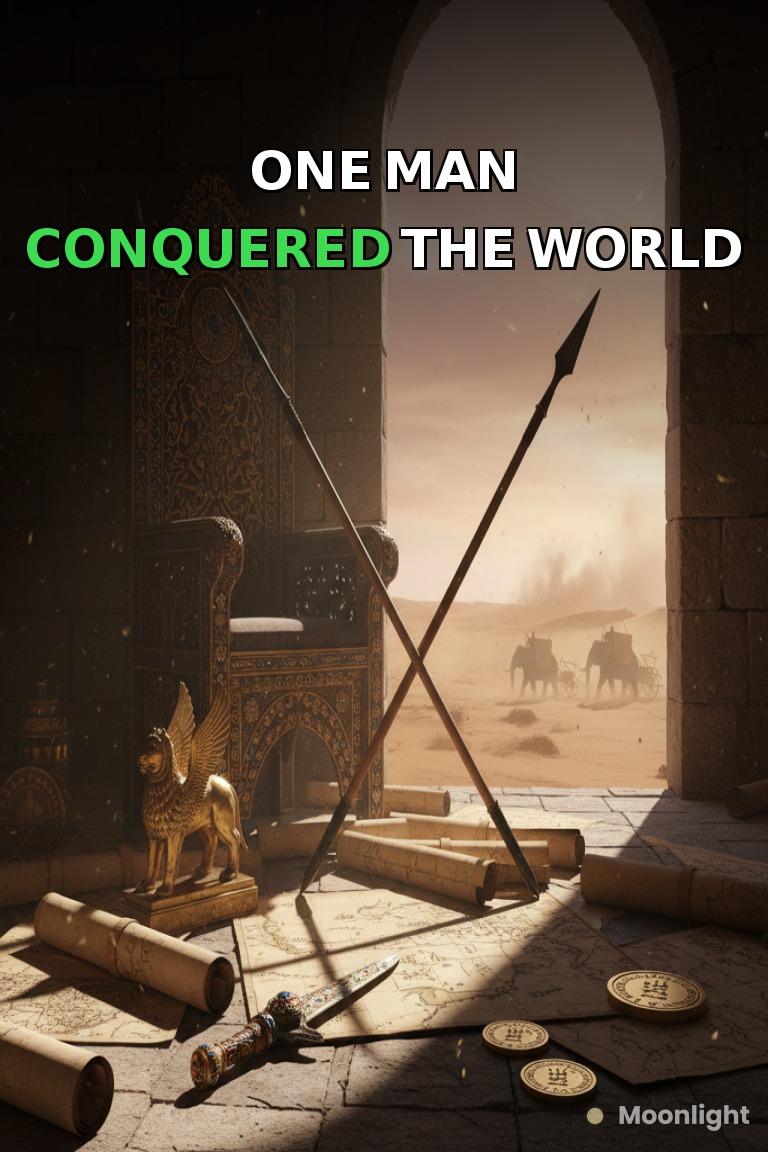
Alexander the Great: How One Man Built an Empire
At just 20 years old, Alexander of Macedonia launched one of history's greatest military campaigns, conquering the vast Persian Empire in a single decade. Discover how this brilliant and fearless leader reshaped the ancient world and became history's most legendary commander.
In 334 BC, a 20 year old Macedonian king began the greatest military campaign in history.
His name was Alexander.
His target: the Persian Empire, superpower of the age.
In just 10 years, he would carve out one of the largest empires ever known.
To Persians, he was Alexander the Accursed.
To the west, he became immortal: Alexander the Great.
Ancient Greece was a land of rugged beauty and fierce rivals.
Two city states dominated: Athens, a democracy of art and philosophy.
And Sparta, a militaristic machine trained for war.
In 480 BC, they joined forces against the mighty Persian invasion.
At Thermopylae, 300 Spartans held an enormous Persian army for three days.
Then came the Greek naval victory at Salamis.
And finally, a decisive Greek victory at Plataea.
The next 50 years were Greece's golden age.
But then everything changed.
Rising tensions between Athens and Sparta dragged Greece into decades of war.
The city states fought each other, not their enemies.
They grew exhausted. Vulnerable.
Then a new power emerged from the north: Macedonia.
For centuries, Greeks had dismissed Macedonia as a backwater, barely Greek at all.
But King Philip II changed everything.
He introduced the sarissa: an 18 foot pike, twice the length of a normal spear.
Wielded by professional soldiers in a phalanx formation, it was unstoppable.
In 338 BC, Philip crushed the armies of Athens and Thebes at Chaeronea.
He united all Greece under the Hellenic League, with himself as supreme commander.
Only Sparta refused to join.
Philip planned a great invasion of Persia itself.
The Persian Empire was immense, but its wealth was ripe for the taking.
But before Philip could launch his war, he was assassinated by his own bodyguard.
The victim of Macedonia's brutal court rivalries.
Philip's 20 year old son inherited the throne.
His name: Alexander.
Brilliant. Restless. Tutored by the great philosopher Aristotle.
Already an experienced military commander.
Alexander inherited his father's grand plan.
But first he had to secure his own position as king.
At home, he executed potential rivals.
He crushed rebellions in Illyria, Thessaly, and central Greece.
Then he made a special example of Thebes: he completely destroyed it.
Its people were sold into slavery.
In spring 334 BC, Alexander was ready.
He led his army across the Hellespont into Asia Minor.
The start of one of history's greatest military campaigns.
Alexander's army was 40,000 strong.
Its backbone: 9,000 Macedonian phalangites armed with the 18 foot sarissa.
Professional soldiers, drilled to perfection.
They formed up 16 ranks deep, presenting a solid wall of iron spear tips.
Virtually unstoppable. But vulnerable on the flanks.
So 3,000 elite shield bearers protected them.
Next came 7,000 Greek allies and 5,000 mercenaries as hoplites.
Comments
ana Ramsaliu
bjki